ECHOLOCATION
While the ability to fly sets Chiroptera apart in the world of mammals, their echolocation skills are under-rated. As previously stated, not all bats are capable of echolocation. But the bats that use it as a primary navigation system are exceptional in the world of animals. As you will soon realize, what bats are doing quite easily, is actually mathematically impossible!
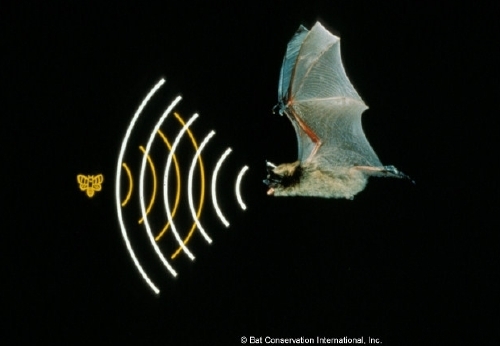
(Thank-you to Dr. Merlin Tuttle, Bat Conservation International for use of this picture)
To view a movie of a bat intercepting an insect using echolocation, click here.
There are a few definitions that are necessary to understand how echolocation works.
Frequency is the pitch of sound. Typically measured in kHz (kilo-hertz which equals 1000 cycles per second), humans hear up to 20 kHz.
Ultra sound is a sound that has a frequency above 20 kHz. Most bats use ultra sound frequencies for reasons forthcoming, but there are some exceptions, even here in Canada!
Intensity is a measurement of how loud sound is. Typical measurements are in decibels (dB). A 20 dB increase in intensity is equivalent to a 10 fold increase in sound. Therefore 120 dB is 10 times greater than 100 dB. Amplitude of the sound is the measure of the air pressure caused by a wave as it travels through the air. Loud sounds combat the problem of attenuation.
Harmonics are multiples of frequency. A call with harmonics is not a pure tone, but a single frequency sound is a pure tone. Complex sound includes harmonics.
These are ordered sequences of related frequencies being the lowest. Each harmonic may be produced with different amplitudes or intensities.
This ncreases discriminatory function because each harmonic is a discrete frequency with an accompanying wavelength. This improves contrast with background.
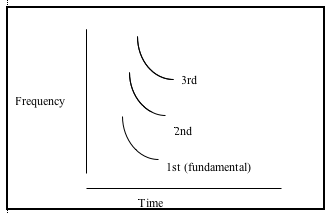
Wavelength of sound is inversely proportional to frequency.
WHY use ultrasonic frequencies?
When the diameter of an object is less than the wavelength being sent towards the objects, then the waves bend around the target rather than being reflected back by the target. So as diameter decreases, echo intensity decreases and is most pronounced at the point where the target is smaller than the wavelength of the sound. Low frequency sounds have a long wavelength, so very little is reflected back. High frequency sounds are REQUIRED to hear echoes off of small targets (i.e. insects). However there is a trade-off. High frequency sound is also reflected off atmospheric moisture and attenuation occurs - the sound does not travel far. Hence, echolocation is short range.
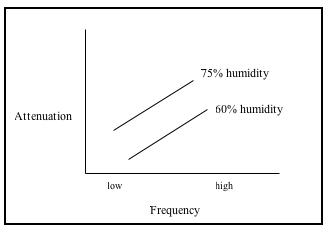
Higher Humidity, more attenuation
Physiology
Calls are generally produced from the larynx. It is a complex sound that the bat can control, unlike tongue-clicking which is a more primitive form of echolocation used by Rosettus. To be effective and defeat attenuation, the call must be made with a very high intensity, typically around 100 dB, which is similar to that of a smoke detector. It would be very easy to overload the auditory system if the bat actually heard the call it made. To defeat this, the bat has middle ear muscles (stapedius muscle) which contracts with the vocalization and dampens the mechanical transfer from the ear drum to the cochlea. Therefore, as a bat is producing the sound, the bat is essentially deafening itself to the sound it is producing. When it stops the call, the muscles relax, and the bat is able then to hear the echoes returning.
This could be a very expensive exercise if it had to be done independently. As it turns out, the contraction of the muscles is related to the muscles being used in flight, and so the cost is not very great for the bat. This also explains why the bat averages one call per wingbeat! (There are exceptions... of course).
What the bat sees
Each echo results in a single picture, a snapshot, of the environment that it bounces back from . This is a non continuous picture, so in order to keep track of a moving object, a high repetition rate is necessary. As a bat approaches a target, the echoes return faster and the bat can increase it’s repetition rate, usually referred to as a buzz.
Probe Distance
Recall that the speed of sound is 344 m/s. If you have 10 pulses per second (repetition rate), each pulse is 1/10 of a second long and will travel 34 meters. This is there and back however, so the bat is waiting (between pulses) for echoes from objects that are less than 17 meters away. To have a 50 meter range, approximately 3 pulses per second.
Bats use a combination of eyesight and echolocation as they move around their world. They rely on eyesight for larger objects, especially objects further away, and echolocation for smaller objects closer to them. The bats of Canada are typically far sighted, in that they have difficulty focusing on objects close to them, and that explains why they may not sense food directly in front of them until they begin echolocating.
Using echolocation, a bat will detect an insect 5 meters away, or a tree 40 meters away.
Using eyesight, a bat will detect an insect 1 meter away, or a tree 286 meters away.
Bandwidth - The bandwidth is how big of a sweep (or how many frequencies are included in the call). A wider bandwidth has a more precise range determination. Bats with FM calls can get range information to a fraction of a millimetre. This is determined from the time delay of the echo. It is likely that they can also detect the phase of the returning echo, and therefore can detect the texture details of the target.
Broadband calls - small range, used for determination and detail of shape and texture of the target, but have a low detection range.
Narrowband calls (CF) - increased range of detection (long range search and target detection), but with loss of precision. All energy is in a single frequency which can travel further and allows for auditory specialization, the bat becomes sensitive to that particular frequency.
Doppler shift - a pulse of sound striking a target moving away from the source, is shifted down (lower frequency) or striking a target moving towards the source is shifted up (higher frequency). By measuring the shift, the bat is able to determine the target velocity.
(insert diagram)
Diagrammatic representation of the relationship between bandwidth and number of harmonics in the ultrasonic signal of a bat and the perceived position of a target or target range. Shaded areas illustrates the bat’s perceptual image of the target (the dot). A to E are different time-frequency signals.
